
How New Jersey Is Turning AI into Better Government Services
Featuring Dave Cole, Chief Innovation Officer, State of New Jersey
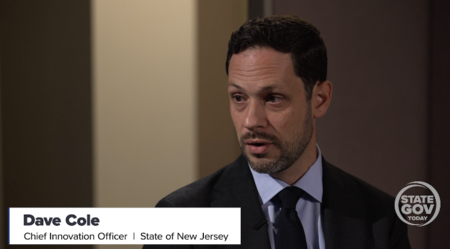 For New Jersey Chief Innovation Officer Dave Cole, successful technology initiatives begin with understanding the problem people need government to solve. AI expands the available options, but the work starts with residents, businesses and public employees—and the obstacles they encounter.
Cole describes an approach built around research, rapid prototypes and continuous feedback. Teams develop something people can use, learn from their experiences and improve it over time. AI can accelerate that process by helping teams create interactive prototypes, although an early demonstration may require substantial rebuilding before it is ready for broader deployment.
New Jersey’s permitting dashboard illustrates how that approach connects transparency with operational improvement. The dashboard brings information about permits across agencies into one place, helping applicants and state officials understand progress and dependencies. Alongside that visibility, Cole identifies opportunities for AI to check whether submitted documents are complete and extract information for staff review.
Similar challenges arise in applications for small-business assistance. Cole explains how a document-validation prototype developed with the state’s Economic Development Authority helped identify missing or incorrect information earlier in the review process. His team is working to adapt that capability into a platform that can support additional programs across government. A common capability could help multiple agencies address recurring administrative problems and reduce delays caused by incomplete submissions.
Workforce readiness supports that expansion. New Jersey pairs its AI awareness training with a state-provided AI assistant, giving employees a place to practice while learning about privacy, security, bias and inaccurate outputs. Guidance within the assistant reinforces responsible use as employees incorporate AI into their daily work.
Together, these efforts connect service improvement with a broader foundation for adoption: trained employees, practical safeguards and capabilities that can be reused across agencies.
3 Key Takeaways
- Start with the service problem. Research and user feedback help determine where AI can improve a process and which solutions warrant further development.
- Build shared capabilities from proven prototypes. New Jersey is adapting document-validation work for use across multiple government programs.
- Pair training with practical access. An AI assistant gives employees hands-on experience while reinforcing privacy, security and responsible use.
How Delaware Is Building the Foundations for AI-Enabled Public Service
Featuring Bob Osmond, Chief Information Officer, State of Delaware
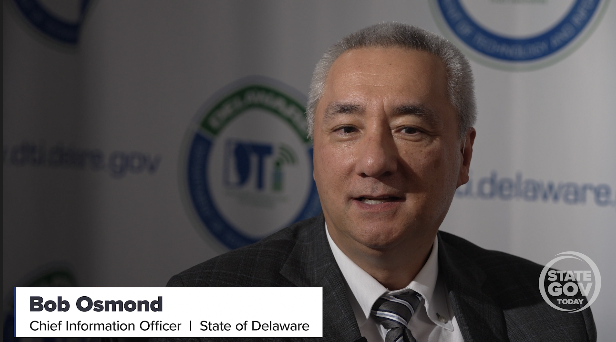 Delaware has invested in studying AI, educating employees and testing potential applications. Chief Information Officer Bob Osmond sees the next challenge as moving more of that work into production environments where it can deliver value to agencies and the people they serve.
That transition requires three connected foundations: technology infrastructure, an educated workforce and governance. Osmond explains that the expanding selection of AI products can complicate decisions, with each new tool creating another reason to keep evaluating. Progress requires choosing a workable path while recognizing that technology and implementation plans will continue to evolve.
Delaware’s mandatory responsible AI training helps establish a common understanding across the workforce. Employees learn what AI does well, where it falls short and how ethical considerations should shape its use. Osmond stresses that employees must review outputs for accuracy, including summaries and meeting transcripts that could become government records.
A recent three-day initiative demonstrated how quickly experimentation can produce useful evidence. Students worked with agencies and industry mentors on ten government use cases, developing proofs of concept grounded in actual operational needs. Osmond says the experience challenged assumptions about how long early development should take and encouraged the state to advance several concepts toward production.
He advocates controlled testing that allows teams to learn and adjust. That approach depends on safeguards around sensitive information and a balance between delivering new services and protecting existing systems. Cybersecurity, in his view, is essential to maintaining the public’s trust in government’s handling of personal data.
Delaware’s decision to make conversational AI available statewide also creates opportunities to support routine work, while technology teams explore AI-assisted software development. The goal is to expand useful adoption while strengthening the people, infrastructure and controls that make it sustainable.
3 Key Takeaways
- Production requires connected foundations. Infrastructure, employee education and governance must develop together as Delaware expands AI use.
- Controlled experimentation can accelerate learning. Agency-defined use cases and student collaboration demonstrated the value of testing practical ideas quickly.
- Human review and cybersecurity remain essential. Employees must verify AI outputs while agencies protect the sensitive information entrusted to government.
Building the Foundations for AI-Enabled Public Service with Granicus
Featuring Karthik Anbalagan, General Manager of Emerging Technologies, Granicus
 Moving AI beyond pilots begins with a clear understanding of the mission an organization needs to accomplish. Karthik Anbalagan, general manager of emerging technologies at Granicus, explains that agencies are better positioned to scale when experiments connect to their most important service-delivery objectives.
Those objectives often cross departmental boundaries. Anbalagan recommends bringing technology leaders, program owners, department heads and executives together early to agree on outcomes, implementation responsibilities and the organizational changes required. Technical decisions about architecture and security need to reflect the needs of the people responsible for delivering services.
Strong governance also depends on foundational work. Agencies need to understand their business processes, data, content and information architecture to establish rules appropriate to their missions. Those foundations help organizations evaluate partners and determine whether proposed solutions can meet public-sector expectations for accuracy, security and accountability.
Anbalagan places particular emphasis on observability: the ability to see what an AI system is doing through its inputs, outputs and activity. That visibility becomes increasingly important as agencies consider workflows involving multiple AI agents. Monitoring each step helps teams identify changes in performance, investigate problems and maintain opportunities for human oversight.
Resident experience provides another source of evidence. By examining where people encounter friction, experience gaps or successfully complete tasks, agencies can identify improvements and assess whether changes are delivering the intended results. Those insights can then guide future investments.
Financial predictability also affects whether AI can scale. Anbalagan discusses the difficulty of fitting highly variable usage charges into fixed government budgets. He argues that partners should help manage underlying compute costs and offer pricing structures that give agencies a clearer understanding of their financial commitments.
Across these areas, the emphasis is on building operational confidence through clear objectives, appropriate foundations, visible performance and sustainable costs.
3 Key Takeaways
- Connect pilots to mission priorities. Shared objectives and early participation from technology and program leaders help establish a path to broader deployment.
- Make AI performance visible. Monitoring inputs, outputs and workflow activity supports accountability and helps identify performance drift.
- Plan for measurable results and predictable costs. Resident insights and sustainable pricing help agencies evaluate value and support continued adoption.
New York Is Building AI Into the Infrastructure of Government
Featuring Eleonore Fournier-Tombs, Chief AI Officer, State of New York
 New York’s approach to AI extends across innovation, governance and education. Chief AI Officer Eleonore Fournier-Tombs describes how those three pillars are shaping the state’s ability to deploy shared tools, support agency-specific needs and prepare employees for new ways of working.
The innovation portfolio includes both general-purpose AI tools and the infrastructure agencies need to develop their own applications. Fournier-Tombs outlines a direction in which a central AI office supports agency innovation labs, giving teams access to environments for experimentation and the technical foundations required for deployment. That structure is intended to build capacity throughout government, with agencies helping identify and develop solutions for their own operational needs.
Governance translates broad principles into practical decisions. New York uses a risk-assessment methodology based on the NIST AI Risk Management Framework to help agencies classify proposed tools and examine issues such as transparency, human oversight, fairness, data protection and accountability. The process asks agencies to establish how results will be checked and who will be responsible for decisions.
Education supports both access and effective use. Employees receiving access to AI tools must complete foundational training covering literacy and ethics. Additional instruction addresses the needs of developers, leaders and other employee groups. Fournier-Tombs emphasizes careful oversight of AI-assisted coding and continued learning as tools and applications evolve.
The state’s regulatory review work offers an example of AI supporting human expertise. AI can analyze large volumes of material and identify regulations that may warrant attention, allowing analysts to focus on evaluating suggestions and determining appropriate changes.
Fournier-Tombs also discusses working with unions and employees to address concerns about AI’s effect on work. She describes a mandate centered on improving work quality, reducing administrative friction and helping employees feel confident using the technology.
New York is pursuing a mix of commercial tools and internal capacity to run models. That approach reflects considerations including cost, security and workforce development as the state builds a broader foundation for AI-enabled government.
3 Key Takeaways
- Build institutional capacity. Shared infrastructure and planned agency innovation labs can support AI adoption across government.
- Turn governance principles into operational checks. Risk assessments help agencies address oversight, transparency and accountability before adopting tools.
- Make workforce development continuous. Foundational training, specialized instruction and employee engagement support responsible adoption as AI evolves.