
Presented by Granicus in partnership with Carahsoft
Delaware’s next challenge with artificial intelligence is turning what it has learned into capabilities that public servants can use. The state has invested in research, employee education and experimentation. Now, Chief Information Officer Bob Osmond wants to move promising ideas into production environments where they can support the work of government.
In this episode of The Future Public Servant, Osmond joins State Gov Today’s George Jackson to discuss the foundations that transition requires: technology infrastructure, an educated workforce and governance that supports responsible use. He also describes how collaboration with students, universities, agencies and industry is helping Delaware rethink its approach to innovation.
Throughout the conversation, Osmond connects those efforts to the people government serves. His perspective combines the strategic responsibilities of a CIO with his experience as an emergency medical technician, where the importance of reliable public services is immediate and personal.
Moving from Research to Everyday Capability
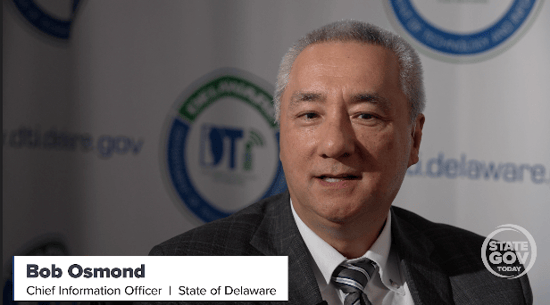 Osmond arrived in Delaware with experience leading technology in Virginia, but he emphasizes that each state has its own operating model. Delaware’s technology organization supports a broad range of institutions, including executive agencies, legislative and judicial functions, and K–12 education. Much of that work is performed by state employees, creating a different environment from Virginia’s reliance on managed contracts for many services.
Those differences matter when deciding how to introduce AI. The technology must fit the responsibilities, workforce and service delivery model of the organization using it.
Osmond describes Delaware as having spent considerable time studying AI, examining other states’ practices and exploring potential applications. Agencies have experimented, and some have developed pilots and proofs of concept. The opportunity now is to put appropriate applications into operational use.
“I think we’re transitioning from the study to the try, and moving into the do,” he says.
He sees that transition as an important challenge over the next year or two. Research and demonstrations establish what might be possible; production use is where those capabilities can begin adding practical value to government.
Osmond also points to a supportive leadership environment. He describes Delaware’s governor as someone who personally uses technology and understands its potential to support transformation and better experiences for residents. That support creates room to act on what the state has learned.
Building Infrastructure, Skills and Guardrails Together
Osmond identifies three requirements for moving forward: technology and infrastructure, an educated workforce, and governance. Together, they provide a foundation for sustained adoption across government.
On the technology side, he argues that the abundance of available tools can make decisions harder. Teams can spend so much time evaluating the next option that implementation never gets underway. Delaware needs to agree on a workable direction and build the infrastructure to support it, accepting that the initial approach will evolve.
Workforce preparation is equally important. Delaware has made responsible AI education mandatory for state employees. That training addresses what AI does well, its limitations, ethical considerations and the rules governing its use.
For Osmond, employees need enough understanding to recognize appropriate applications and use the technology thoughtfully. He says the training has helped build a culture in which AI is viewed as an opportunity rather than something to fear.
Governance includes both policies and protections within the technology environment. Osmond compares the latter to safeguards in email systems that can intervene when someone inadvertently attempts to send sensitive information. AI environments also need guardrails that help prevent mistakes and keep activity within appropriate boundaries.
His framework links organizational readiness to practical execution. Infrastructure provides a place to work, education prepares people to use it, and governance helps them do so responsibly.
Keeping Human Expertise in the Process
 The role of employees becomes especially clear in Osmond’s discussion of generative AI. He describes capabilities that can help with conversation, content creation and other tasks, while emphasizing that the output still requires careful review.
An AI-generated summary may omit the points a person considers most important. A transcription system may attribute a statement to the wrong speaker. If that output becomes an official record, those errors matter.
“You have to still fact check the results and make sure they’re accurate,” Osmond says.
Responsible use therefore requires people to examine, shape and verify the content. Employees bring the context and judgment needed to determine whether a result faithfully represents the underlying information and serves its intended purpose.
Osmond also highlights bias. The data used to train a model can influence its outputs, and employees need to remain attentive to that possibility. Understanding these limitations is part of becoming an effective practitioner.
Delaware has decided to make conversational AI available across its workforce, giving employees access to assistance with documentation, summarization, file creation and questions. Osmond also describes software developers using AI tools to explore ways to create software more effectively.
These examples show how AI can support the work of public servants. The interview describes adoption and intended benefits rather than quantified improvements in productivity or resident services. Human review remains essential as the state expands access and learns where these capabilities are useful.
Connecting Agencies, Students and Industry Around Real Problems
 A three-day initiative gave Delaware a practical demonstration of what collaboration could produce. The state asked agencies to identify problems they believed AI might help address. Agencies submitted close to 20 ideas, which were narrowed to 10 use cases.
Students from universities and, in some cases, high schools worked in small teams alongside industry partners and the agencies that had submitted the problems. Agencies provided business context, while mentoring and support helped the students develop their ideas.
Within three days, teams produced proofs of concept that demonstrated potential capability and value. For Osmond, the experience challenged the assumption that agencies needed to spend months studying an opportunity before trying it.
“We’re being far too cautious,” he says, describing what the experience helped the state recognize.
The lesson was that controlled experimentation can help teams learn and decide whether to proceed. A bounded test does not have to become a permanent commitment. If an approach fails, the organization can step back, use what it learned and move on.
Osmond says Delaware is taking several of the student-developed ideas forward toward production. Doing so creates an immediate need for the technology, people and governance required to support them.
The initiative also connected young people with the mission of government. Some students approached agencies about continuing to help. Osmond sees an opportunity to bring more junior talent into public service, adding fresh perspectives to longstanding challenges.
Broadening the Conversation About Responsible Adoption
Delaware’s AI Commission provides another forum for collaboration. Osmond describes it as bringing together participants from higher education, agencies, industry and government to examine challenges and help shape the state’s approach.
Its work has informed responsible AI education and training, as well as discussions about policy and infrastructure. For a technology leader, that broader perspective can reveal questions that an implementation-focused team might overlook.
Osmond values the opportunity to examine problems from several viewpoints before deciding how to proceed. The commission helps the state consider AI comprehensively, drawing on expertise beyond the technology organization.
The commission and the student initiative serve different purposes, but both connect people around shared government challenges. One helps shape the conditions for responsible adoption; the other tests potential solutions with direct agency participation.
Together, they illustrate how Delaware is drawing on a wider network of expertise as it works toward operational use.
Balancing Delivery with Public Trust
Osmond describes technology delivery and cybersecurity as two halves of the same coin. Government must advance services and projects while protecting the information and systems entrusted to it.
An organization focused solely on delivery can expose itself to vulnerabilities or rush systems into production before they are ready. An organization focused entirely on defense can become so cautious that improvement stalls. Effective leadership requires both responsibilities to work together.
That balance is especially important in government, where agencies hold sensitive information associated with courts, criminal justice, health, social services and other interactions with residents. People need confidence that their information is being handled with care.
“Cybersecurity is essential when it comes to having trust in government,” Osmond says.
He favors cautiously introducing AI in controlled, low-risk settings and using that experience to refine the governance surrounding it. Waiting for every policy question to be resolved can keep an organization from trying anything, while testing without appropriate limits can create avoidable exposure.
His approach ties progress to learning: introduce a bounded use case, understand what happens, and determine what additional protections or policies are needed. The purpose is to make responsible improvement possible while maintaining the trust that public service depends on.
Keeping the People Government Serves in View
Osmond’s experience as an EMT gives him a direct connection to that mission. He pursued certification during the beginning of COVID, when hospitals and public services were under pressure, because he wanted to help.
Working with patients provides a different perspective from the strategic and sometimes abstract responsibilities of a CIO. Helping someone through an emergency makes the importance of public services tangible.
“This is not abstract; it is real. We’re touching lives,” he says.
He connects that experience to the systems supporting 911, dispatch, education and first responders, as well as the work of agencies serving people every day. Technology decisions matter because people depend on the services those decisions support.
That perspective gives Delaware’s AI efforts a clear purpose. Moving from experimentation into production requires more than selecting a tool. It requires employees who understand its capabilities, infrastructure that supports their work, collaboration that helps solve meaningful problems, and safeguards that preserve public trust.
For Osmond, the value of those investments ultimately rests in the mission of state government: helping make life better for the people it serves.
About The Future Public Servant
This interview is part of The Future Public Servant, a State Gov Today initiative presented by Granicus in partnership with Carahsoft. The program explores how artificial intelligence, emerging technology and new approaches to leadership are changing public service—and how governments can prepare their workforces for what comes next. Additional interviews and resources are available at TheFuturePublicServant.com.