
Presented by Granicus
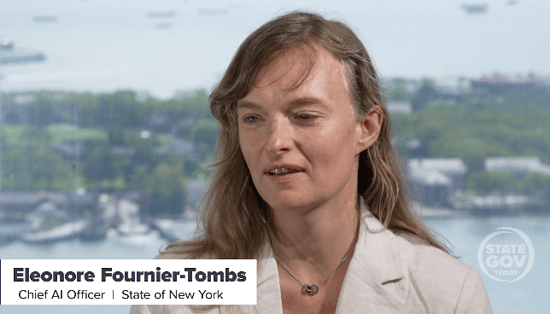
New York State is moving beyond a project-by-project approach to artificial intelligence. Its long-term objective is to build the shared infrastructure, governance processes and workforce capabilities that allow agencies to use AI safely, consistently and at scale. In a conversation with State Gov Today’s George Jackson in New York City, New York Chief AI Officer Eleonore Fournier-Tombs explained how the state is creating that institutional foundation—and why technology must ultimately support public employees and improve the services New Yorkers receive.
When Fournier-Tombs became New York State’s chief AI officer, she stepped into a position that was still taking shape.
Chief AI officer roles are new across state government, and their mandates are often not fully defined when the first person enters the position. While the broad responsibility may be to guide responsible AI adoption, each state must determine how the office will operate, how it will work with individual agencies and what capabilities should be managed centrally.
Approximately nine months into the job, Fournier-Tombs said New York has organized its AI work around three pillars: innovation, governance and education.
 Those pillars are not separate initiatives. Together, they form an operating model for building AI into the state’s broader technology environment. Innovation provides agencies with tools and infrastructure. Governance establishes the safeguards that allow those capabilities to be used responsibly. Education prepares employees and leaders to apply them effectively.
“Governance is a significant part of what we do, but it’s only one of the three pillars of our team,” Fournier-Tombs said.
Building a statewide AI infrastructure
The innovation pillar is responsible for more than developing individual applications. Its larger purpose is to establish the shared technical foundation agencies need to adopt AI based on their particular missions.
That work includes deploying general-purpose capabilities across state government, developing data and AI infrastructure, providing procurement guidance and helping agencies determine which technologies are appropriate for their needs.
New York has made an AI Pro tool based on Google’s Gemini large language model available across the state. It is one example of a capability that can be deployed centrally and used by employees in multiple agencies. The specific product, however, is only one component of the state’s larger strategy.
The more consequential work involves creating a repeatable way for agencies to evaluate, acquire, govern and deploy AI. Rather than requiring every department to create its own approach, the Chief AI Office can provide common infrastructure and guidance that agencies can adapt to their own missions.
When a need is highly specialized—such as an application for the Department of Labor or Department of Health—the central office can provide development support, technical expertise and infrastructure guidance.
New York’s distributed IT structure helps connect the statewide strategy with agency-level priorities. A deputy commissioner of technology is assigned to each agency, giving the Chief AI Office a partner who understands the organization’s mission, operations and technology needs.
This structure allows New York to combine centralized capabilities with distributed innovation. The state can establish common foundations while leaving agencies close to the work and the residents they serve to identify the problems worth solving.
From isolated projects to an innovation ecosystem
 Fournier-Tombs said New York’s direction is to move away from a model in which the Chief AI Office handles one small project at a time.
Instead, the state is developing an innovation strategy that would give agencies the infrastructure and controlled environments needed to explore their own ideas. The vision includes a central Chief AI Office supported by innovation labs within agencies that have the interest and capacity to establish them.
Those labs could provide sandbox environments in which agency teams test AI applications before moving them into operational use. They would also give agencies access to the data layers, models and technical infrastructure required to turn a successful experiment into a sustainable capability.
The distinction is important. A pilot can demonstrate that a technology works in a limited setting. Institutional capability allows an organization to repeat that success, apply what it learned elsewhere and support the resulting system over time.
“We’re thinking about AI innovation as an ecosystem of teams,” Fournier-Tombs said.
Under that model, the Chief AI Office would spend less time developing individual applications and more time creating reusable foundations. Agencies would be able to pursue projects based on their missions without independently recreating every technical and governance component.
Building that ecosystem will take time. New York must establish infrastructure, determine how the agency labs will operate and put the necessary data layers and models in place. But the intended result is an organization that is prepared to use AI over the long term—not simply a collection of disconnected demonstrations.
Governance as an enabler of responsible adoption
A shared AI foundation also requires a common understanding of risk.
New York’s acceptable-use policy establishes principles for government AI systems. Applications must be transparent, include appropriate human oversight, consider bias, fairness and equity, protect data and respect intellectual property.
 The central question for the Chief AI Office was how to translate those principles into a process agencies could use when evaluating real applications.
New York developed an AI risk-assessment methodology based on the National Institute of Standards and Technology’s AI Risk Management Framework. When an agency wants to adopt an AI system, it completes a preliminary assessment that categorizes the proposed use as low, medium or high risk.
The agency is then guided through a more detailed review addressing transparency, accountability and human oversight. Among the questions agencies must answer are who is responsible for the system, how its results will be checked and how the state will ensure that a person remains involved in consequential decisions.
This process makes governance part of the state’s AI operating model rather than a review that happens only after a tool has been selected. It gives agencies a consistent framework for considering risk while still allowing them to pursue applications relevant to their work.
Governance, in that sense, is not separate from innovation. It creates the conditions under which innovation can move forward responsibly and with greater public confidence.
Preparing more than 100,000 employees
Technology and policy alone cannot create institutional readiness. New York must also prepare its workforce to use AI appropriately.
The state worked with InnovateUS, a nonprofit organization that provides training for public-sector professionals, to develop a two-hour asynchronous course in AI literacy and ethics.
Employees who receive access to a state-authorized generative AI platform must complete the training. The course provides a baseline understanding of what the technology does, the responsibilities that come with using it and where employees can go for assistance.
More specialized instruction is then aligned with an employee’s role.
New York is developing training for leaders responsible for introducing AI in highly scrutinized government environments. It is also training experienced developers to use AI in software development, legacy application modernization, code review and cybersecurity.
Fournier-Tombs rejected the idea that government developers should engage in casual “vibe coding.” AI-generated code used in state systems requires technical expertise, testing and careful oversight.
“We’re doing really careful deployment of these tools,” she said. “We’re really thinking through how we’re using AI for code modernization or for code scanning.”
The training strategy reflects a broader view of human and AI collaboration. The goal is not to remove expertise from government processes. It is to help employees use technology to extend that expertise, work through large amounts of information and address labor-intensive tasks more effectively.
New York does not expect the need for training to end. As the technology changes and the state’s experience grows, its education programs will become more specialized. Workforce readiness will remain an ongoing organizational capability rather than a one-time requirement.
Helping public servants focus on higher-value work
Concerns about AI’s effect on employment arise in nearly every public conversation Fournier-Tombs has about the technology.
She said people experience that concern on a personal level. They want to know whether AI could take their jobs and threaten their ability to support their families.
New York’s Future of Work initiative is examining how AI could affect workers across the state and what policymakers can do to support New Yorkers through a significant economic and societal transition.
Within state government, Fournier-Tombs said the mandate is clear: New York is not introducing AI to replace employees.
The state wants to improve the quality of their work, reduce administrative burdens and remove some of the bureaucratic friction that can make government processes difficult for employees and residents alike. The Chief AI Office is engaging unions, agencies and employees as it develops that approach.
“Our ultimate mandate is really upskilling everybody so that the workers themselves feel confident and empowered to use AI,” Fournier-Tombs said.
Public employees also have an essential role in determining where AI should be used. They understand the processes, recurring problems and service needs within their agencies. Giving them the skills to evaluate AI allows them to help shape the state’s investments rather than simply receive technology selected elsewhere.
The intended partnership is one in which AI processes information, accelerates routine work and surfaces useful findings, while public servants contribute context, judgment and accountability.
Applying human judgment at greater scale
New York’s regulatory reset initiative illustrates that division of responsibility.
The state is using AI to assist in reviewing thousands of regulations and policies that have accumulated over time. Some may need to be updated, while others may no longer be relevant.
Reviewing that volume of information entirely by hand would require an extraordinary amount of time. AI can process the material rapidly and identify regulations that may warrant further examination.
Human analysts then review those suggestions and determine what action, if any, should be taken.
The technology does not replace human judgment or make policy decisions. It allows employees to direct their attention toward the analysis and decisions that require their expertise.
“It allows us to process masses and masses of information in a way that you couldn’t do just by hand,” Fournier-Tombs said.
For residents and businesses, the potential outcome is a body of state policy that is easier to maintain and more appropriate to current needs. For employees, it is an opportunity to spend less time manually sorting information and more time evaluating what that information means.
Connecting AI investments to public outcomes
Government leaders face pressure to demonstrate that investments in AI are producing meaningful results. At the same time, they must respond to concerns about risk, cost and the impact on workers.
Fournier-Tombs described the environment surrounding AI as one of simultaneous impatience and fear. Leaders want evidence of progress, but they also want assurance that new systems are safe, grounded and worthy of public investment.
New York is beginning to measure the effects of its deployments. Some of the clearest opportunities are appearing in code modernization and cybersecurity, where AI can help the state address large technology workloads and maintain legacy systems.
The state also sees potential in customer service, including the first level of triage when residents submit questions, requests or claims.
Those applications connect AI investment to an outcome residents can recognize: a government that responds more effectively. The measure of progress is not simply whether an agency deployed a new tool. It is whether employees can work more efficiently, systems are more secure, services are easier to navigate and the state can respond more effectively to public needs.
Bringing research into public service
New York is also investing in a broader research ecosystem through Empire AI, a consortium based at the University at Buffalo.
Empire AI gives university researchers access to computing infrastructure they can use to pursue AI research benefiting New York residents and other public purposes.
The Chief AI Office does not direct that research. Academic researchers maintain their independence. Fournier-Tombs instead views state government as a potential beneficiary—and, in some instances, a future client—of the work.
As researchers develop new tools, governance approaches and findings, New York agencies may be able to apply those advances to public services. Empire AI therefore expands the state’s innovation ecosystem beyond government while preserving the independent role of academic research.
A hybrid model for long-term readiness
New York’s infrastructure strategy is evolving along with the AI marketplace.
Commercial platforms continue to offer powerful models, extensive support and regular updates. The state is pursuing enterprise agreements that can make those capabilities available across its agencies.
At the same time, improvements in open-source and open-weight models are giving New York more options for building internal capacity. The state is investing in infrastructure that could allow it to operate some models within its own environment.
That internal capacity could help New York manage costs, strengthen certain security controls, train its technical workforce and address environmental considerations.
Fournier-Tombs expects the state to use a hybrid model. Some applications will rely on proprietary commercial systems, while others will use open-source technologies running within state infrastructure. The appropriate choice will depend on the mission, risk, data and operational requirements of each deployment.
The larger strategy is not about making one platform the center of New York’s AI program. It is about giving the state enough capability and flexibility to make deliberate choices.
By investing in shared infrastructure, consistent governance, agency-level innovation and workforce development, New York is working to make AI part of the institutional capacity of government. The ultimate test will not be how many AI projects the state launches, but whether those foundations help public servants work more effectively and enable agencies to deliver better outcomes for New Yorkers.
This interview is part of The Future Public Servant, a State Gov Today initiative presented by Granicus in partnership with Carahsoft. The program explores how artificial intelligence, emerging technology and new approaches to leadership are changing public service—and how governments can prepare their workforces for what comes next. Additional interviews and resources are available at TheFuturePublicServant.com.